
Is it brilliant marketing or exploitative? Is it a sign of the times? Something to chew on.
I’ve rewritten this post several times. Something has been gnawing at me. It didn’t ring true.
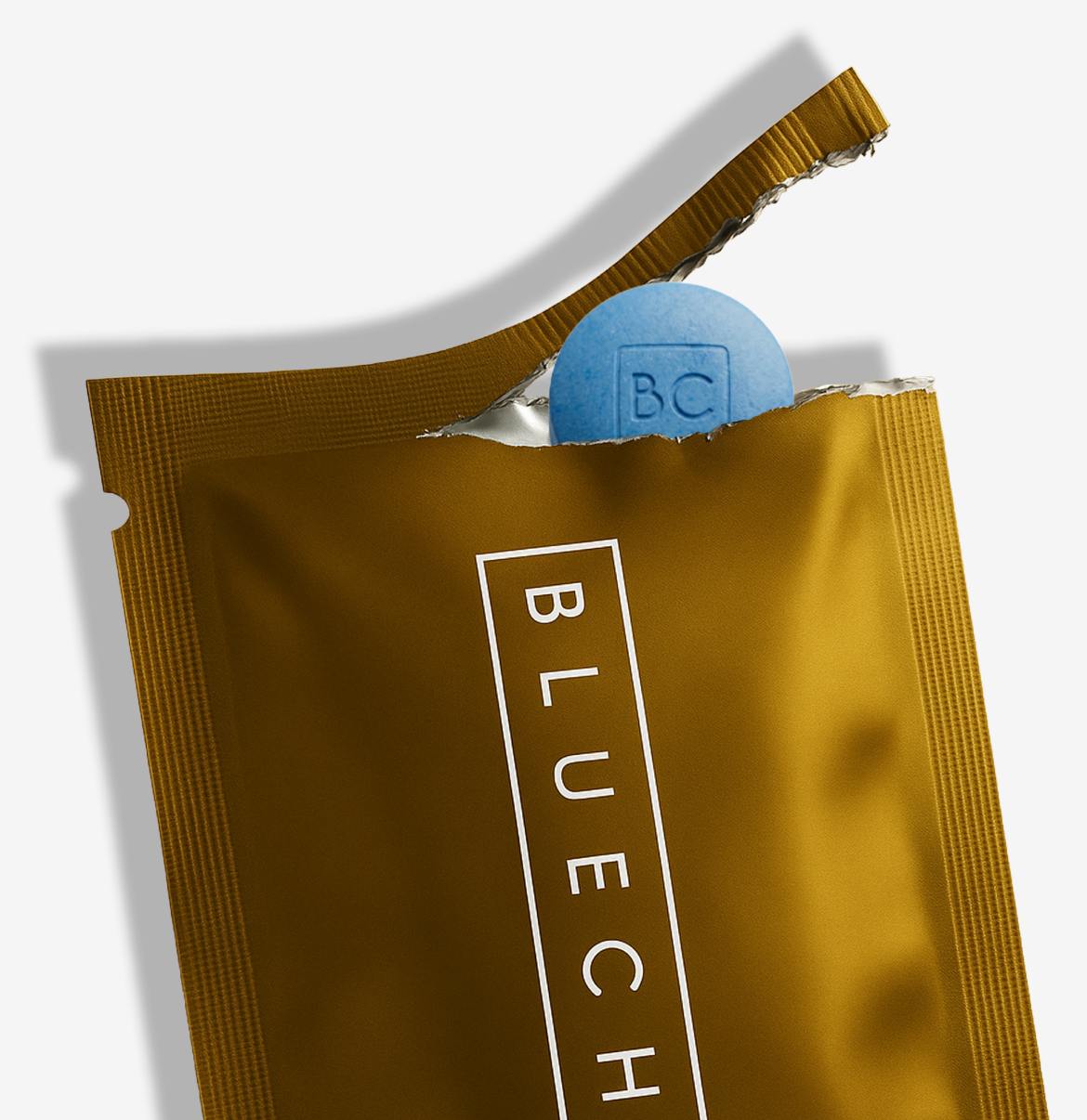
Here’s what it is. I admire Blue Chew. & it unsettles me. At once.
Question: When does bold creative strategy owe its audience more than boldness?
As someone who builds Challenger Brands for a living, I know exactly how easy it is to mistake sensational for smart. Seductive over productive.
In our attention economy, it’s tempting to confuse the two.
Fashion & beauty live on the edge of attention & outrage. From Brooke Shields (Calvin Klein) to Sydney Sweeney (American Eagle). The test is always the same: Does it build business? Or just momentary buzz?
Pharma. Not so much.
Strict regulatory caution, serious tone, clinical language, category conventions result in limp emotional hooks & the absolute safest, most blandini story arc.
A handsome older couple looks sad. The man or woman talks to his or her doctor who prescribes some bizarrely named drug - like “Catastrafil” - accompanied by a list of super-scary side effects. Once treated, they stroll hand in hand off into the sunset. The end.
Bold creative leaps are strictly verboten.
Then, there’s Blue Chew, the chewable, sublingual erectile dysfunction (ED) medication that makes getting hard easy. Take it anywhere, use it any time: date night, 2-month anniversary, tropical getaway & in a fast 15, wham, you’re up for anything.
It’s a far cry from Cialis’s older couple holding hands in separate clawfoot bathtubs on a hilltop, staring at the horizon. Waiting for the fireworks.
Blue Chew sells compounded versions of the same ingredients as Viagra & Cialis - Sildenafil, Tadalafil, plus Apomorphine & Oxytocin. Remade by a pharmacy instead of shipped by Pfizer.
No FDA approval. No FDA ad rulebook. No predictable format. The only fine print: the FDA does not approve or verify compounded drugs for safety, effectiveness, or quality.
Without the FDA breathing down their neck: “Abide by the rules or I’ll huff & I’ll puff & I’ll blow your house down”, Blue Chew can claim to be behind 250 million unforgettable nights.
Instead of the usual tropes, Blue Chew built its name on clever legal formatting, double entendres, innuendo, wordplay & internet-worthy lingo: “The perfect package for your perfect package,” “Erection Resurrection,” “Chew it & Do it.” Treating ED as a lifestyle choice & party drug. They never even mentioned ED, while traditional Viagra & Cialis communications still cling to clinical problem-solution strategy.
This gave Blue Chew social media virality & a hall pass to reach young men on TikTok. & you couldn’t turn on the TV without seeing a chorus of sexy young women touting the epic sex they were enjoying thanks to Blue Chew. All sizzle, no fizzle.
It was confident. It was culturally fluent. & definitely cocky (sorry, I couldn’t resist). The exact opposite instinct of everything the category has been trained to do.

Now Ro sparks has upped the ante with a high-profile telehealth campaign starring Megan Fox in a skintight red catsuit portraying herself as the human embodiment of erectile-dysfunction. Opening the spot with the line, “Hi, I’m not Viagra”.
Turns out the FDA agrees something’s off. Last year, they sent Blue Chew’s parent company a warning letter for implying its compounded pills were “the same as” FDA-approved Viagra & Cialis. They’re not. Legally, that’s misbranding.
Push right up to the line, see who blinks.
Here’s the twist. Two months later, Blue Chew changed the tone. More humor. More couples.
A “Group Chat” spot told from a female-forward perspective. Their creative director says the goal was to shift the conversation “from really clinical to something that feels a little more human.”
Why? Maybe conscience. Maybe saturation. Their CEO says awareness of the category has hit a ceiling. Maybe that warning letter.
Probably all three.
Which makes it harder to judge, not easier.
I’m still wincing.
But this isn’t really about whether Blue Chew is brilliant or exploitative. That’s the debate everyone else is having. It’s still the wrong question. The one I opened with is the real one.
Is it sensational or smart?
I admire the daring, the guts to go against the category.
Blue Chew found a way to move away from pharma’s stiff formula: aging & illness toward young & healthy, normalizing a common performance hurdle versus an age-related disease.
“Hey, you don’t need to be some old dude to experience erectile dysfunction.” A genuinely useful reframe for a touchy subject most brands are too timid to touch.
I worry about the consequences.
Research puts ED prevalence in men under 35 somewhere between 20% & 30%. Real, not rare. But lifestyle & psychological factors like performance anxiety, stress, high alcohol consumption & lack of sleep drive a large share of those cases.
What happens when a pill becomes the first answer instead of the last one? Will they start to depend on the drug just to perform at all?
Toxic masculinity is nothing new. A form of social power that’s centuries old.
I guess I always hoped we had evolved. But it seems in the year 2026 we are sinking deeper. It seems vibrant & alive these days.
I’m not saying a chewable pill causes it. I’m asking what it’s feeding.
Scott Galloway’s best-seller, Notes on Being a Man, sounds the alarm on this generation of young men. & it ain’t pretty. Isolated, aimless, & quietly struggling with what being a man means today. That’s exactly the audience a brand this clever should be most careful with. Not least because a generation this adrift is already vulnerable to voices selling easy answers.
Is its popularity a symptom of a culture that reveres sexual prowess & hypermasculinity over intimacy & connection?
Is it a gateway drug for the manosphere? Is it perpetuating a toxic cycle of emotional manipulation?
Or contemporary example of vintage inadequacy marketing, dressed up in TikTok clothing. Remember: the heartbreak of psoriasis. Halitosis. Body odor.
& finally, I am concerned about the long-term effects.
If ED is truly a medical trend, someone better take it more seriously. & soon. Is it a sign of a bigger health problem brewing - obesity, cardiovascular disease, drugs, mental health issues - as young men enter adulthood?
If so, Blue Chew isn’t the headline. It’s the symptom.
Therein lies the conundrum. The same audacity that let Blue Chew tear up pharma’s formula in favor of fun is the audacity that makes it easy to overlook who’s actually on the receiving end.
Good strategy doesn’t get to stop at “Did it work.”
It has a responsibility to ask: “At what cost. & to whom.”
& then decide, on purpose, how to execute that.
Not because regulation demands it. But because responsibility doesn’t become optional just because nobody’s enforcing it. Yet.
Which leaves me exactly where I started. Impressed. Uneasy. Still chewing.
Every category has its formula. Most brands spend their whole existence following it. Like lemmings.
A rare few finally get brave enough to tear it up. Those are the true Challenger Brands.
The real test isn’t who’s bold enough to break with tradition. It’s who’s responsible enough to know what they’re on the hook for once they do.
For your consideration.
Best, Robin